How the Visegrád Group Actually Works: A Plain-Language Explainer
What the V4 is, what it does and does not do, and how four countries coordinate on practical matters without a shared government.
The Visegrád Group, usually shortened to V4, is a loose arrangement among four Central European countries: Czechia, Hungary, Poland and Slovakia. It has no permanent headquarters, no army and no budget of its own. It works through meetings — of prime ministers, ministers, and lower-level officials — and through agreements that each country carries out in its own way. Readers often ask us whether the V4 is a kind of mini-European Union or a formal alliance. It is neither. To understand the group, it helps to start with what it was created to do, then look at how a typical working year unfolds, as we did when writing about four countries and their shared habits.
What the V4 is, and what it is not
The Visegrád Group takes its name from a small Hungarian town on the Danube where, in 1991, the leaders of what were then Czechoslovakia, Hungary and Poland met to coordinate their efforts after the end of communist rule. When Czechoslovakia split peacefully in 1993, the group settled into its present four members: Czechia, Hungary, Poland and Slovakia.
It is best understood as a <strong>platform for conversation</strong>, not a governing body. There is no V4 parliament, no V4 citizenship and no V4 law that applies in any of the four countries. When the group issues a statement, it reflects agreement among governments at that moment. It does not bind anyone for long.
This looseness is deliberate. For smaller countries, joining a larger group can make a point more visible in Brussels or in other capitals. For all four, it leaves room to disagree. When they disagree — and they do — the group simply stops speaking as a group on that subject and each country goes its own way.
How a working year looks
There is no fixed schedule written in stone, but the pattern is fairly stable. The four prime ministers meet at least once or twice a year, usually in one of the four countries. A rotating presidency, held by each country in turn for a year, sets the topics and hosts the main meetings. Ministers responsible for transport, energy, agriculture or culture meet separately, often more often than the prime ministers.
| Level | Who meets | What they produce |
|---|---|---|
| Prime ministers | The four heads of government | Joint statements on broad positions |
| Ministers | Transport, energy, agriculture, culture | Practical cooperation plans and agreements |
| Experts and officials | Working groups | Reports, studies, shared positions for EU meetings |
| Presidency | One country leads for a year | Sets the agenda and hosts the main events |
A good way to picture it is a series of overlapping conversations rather than a single institution. Over the course of a year, a transport minister might agree with counterparts to improve a rail link, while an energy official shares data on winter gas storage. None of this requires a head office. It does require trust that the partner on the other side of the table will keep talking, which is perhaps the group's most valuable asset.

Why it matters locally
For readers outside the region, the V4 can appear as a single foreign-policy bloc. In practice, its most visible effects are practical and local. Cross-border transport is one example: roads and railways that cross the four countries are planned with neighbours in mind, and the V4 gives officials a standing venue to discuss them. Energy security is another: the countries share an interest in diversifying supply, and they regularly compare notes on storage and interconnectors. Cultural cooperation is a third, with exchanges and shared exhibitions that rarely make headlines but keep working relationships alive.
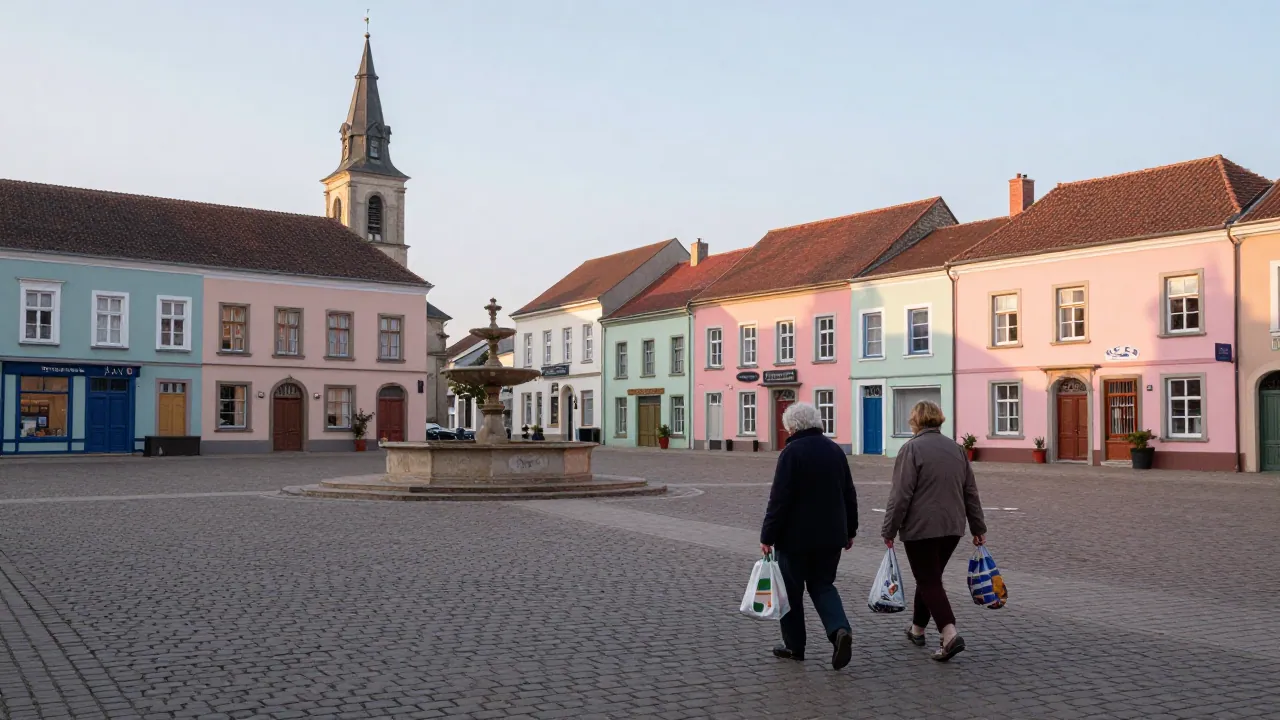
This is also where a reader can see the group most clearly. A small town near a border may notice a new bus link or a shared cultural festival. These rarely carry a V4 label, but they often grew out of conversations the group made possible. If you have read our piece on why so many Central European towns have two names, you already have a sense of how borders shape everyday life here. The V4 is one small way the four countries try to make those borders less of a barrier.
Common misconceptions
The most common misunderstanding is that the V4 is a formal alliance or a mini-EU. It is neither. Another is that the group always votes together in the EU. In practice, the four countries coordinate on some issues and diverge on many. A third misconception is that the V4 has a budget and staff. It does not; each presidency covers its own costs, and the work is done by national officials who have other jobs.
- <strong>It is not a treaty organisation.</strong> The V4 rests on declarations and habits, not a founding treaty with enforcement powers.
- <strong>It does not act for its members.</strong> Each country speaks for itself unless a joint statement says otherwise.
- <strong>It is not a rival to the EU.</strong> Much of its work is about preparing for EU meetings and coordinating positions before them.
- <strong>It is not always united.</strong> On some topics, differences are openly acknowledged and the group stays quiet.
How to follow it as a reader
If you want to keep an eye on the V4, start with the rotating presidency. Each year, one country publishes a work programme, usually in English as well as its own language, and hosts the main events. The joint statements are short and often general, but they show where the group is comfortable agreeing. For everyday texture, local news from border regions is often more useful than the official communiqués. And if you are planning a trip through the region, our guide to riding Czech trains shows how the practical side of travel works on the ground.
We find it helpful to think of the V4 as a set of habits rather than a structure: four countries that have agreed to keep a table open. What gets discussed there changes with the year and the government. The habit itself is the thing worth understanding.
Questions people ask
Is the Visegrád Group part of the European Union?
No. The V4 is a separate informal group. All four members are also EU member states, and much of the group's work involves coordinating positions before EU meetings, but it has no role in EU law or decision-making.
Does the V4 have a headquarters?
No. There is no permanent building or secretariat. Meetings take place in the country holding the rotating presidency or in another member country, and officials handle the work alongside their normal duties.
Why is it called Visegrád?
The name comes from the Hungarian town of Visegrád, where the first meeting of the group's predecessors took place in 1991. The town itself is a small place on the Danube, known to visitors for its hilltop castle.