How to Read a Hungarian Menu Without Guessing
A practical walk through common Hungarian menu terms and regional dishes, so you can order with confidence and know what will arrive at the table.
Hungarian menus can feel like a puzzle even if you speak a little of the language. The names are often descriptive but long, and the same dish may appear under different regional guises. This guide is for travelers who want to order without pointing blindly or defaulting to the English menu, and for anyone curious about what those words actually mean. We will walk through the vocabulary you need, show you how a menu is usually organized, and explain the dishes you are most likely to meet. By the end, you should be able to read a menu in Budapest, Pécs or a village csárda and have a fair idea of what will arrive. For a broader look at how we approach food and place, see our notes on mapping seasonal markets.
A Hungarian menu is usually divided into clear sections, even if the words look unfamiliar. Start by finding the headings: <strong>előételek</strong> (starters), <strong>levesek</strong> (soups), <strong>főételek</strong> (main courses), <strong>köretek</strong> (side dishes), and <strong>desszertek</strong> (desserts). Many places also offer <strong>napi menü</strong> (menu of the day) at lunch, which is usually a set of soup and main for a fixed price. If you see <strong>ajánlat</strong>, that means offer or special. The names of dishes often include the cooking method, so learning a few verb forms helps: <strong>rántott</strong> means breaded and fried, <strong>sült</strong> means roasted or baked, <strong>párolt</strong> means steamed or braised, and <strong>grillezett</strong> means grilled. Once you spot these, the rest of the name is usually the main ingredient and perhaps a garnish.
Meat is central to many dishes, and the words for animals and cuts are worth knowing. <strong>Csirke</strong> is chicken, <strong>sertés</strong> is pork, <strong>marha</strong> is beef, and <strong>hal</strong> is fish. <strong>Borjú</strong> is veal, and <strong>bárány</strong> is lamb. <strong>Tyúk</strong> is hen (older chicken, often used in soups), while <strong>kacsa</strong> is duck and <strong>liba</strong> is goose. If you see <strong>mell</strong>, it means breast; <strong>comb</strong> is leg or thigh; <strong>karaj</strong> is loin; and <strong>szűz</strong> is fillet. Many menus also list <strong>feltét</strong> or <strong>köret</strong> separately, so you may need to order rice, potatoes, or salad on the side. The word <strong>sült krumpli</strong> means fried potatoes, <strong>hasábburgonya</strong> is French fries, and <strong>párolt rizs</strong> is steamed rice. A helpful phrase: <strong>Mi ez?</strong> (What is this?) or <strong>Miből készül?</strong> (What is it made from?).
Step-by-step: reading the menu
Here is a simple routine we use when faced with an unfamiliar Hungarian menu. It slows things down and helps avoid surprises.
- Find the section headings and decide whether you want a soup, a main, or both. Lunch menus often combine them.
- Look for the main ingredient in each dish name. The first word is often the meat or vegetable, followed by the cooking method.
- Check for sides included. Some mains come with <strong>köret</strong>, others do not; the menu may say <strong>körettel</strong> (with side dish) or <strong>köret nélkül</strong> (without).
- Note any words about spiciness or richness: <strong>csípős</strong> means spicy, <strong>tejfölös</strong> means with sour cream, and <strong>hagymás</strong> means with onions.
- If you are unsure, ask the server: <strong>Mit ajánl?</strong> (What do you recommend?) or <strong>Ez húsos?</strong> (Is this meaty?).
You do not need to memorize everything. A small notebook or a phone note with the key terms can be enough. Over a few meals, the patterns become familiar. For more on how we prepare for research trips, see our account of a week in the Tatra foothills, where we applied similar methods to reading local food signs.
Common dishes and what they look like
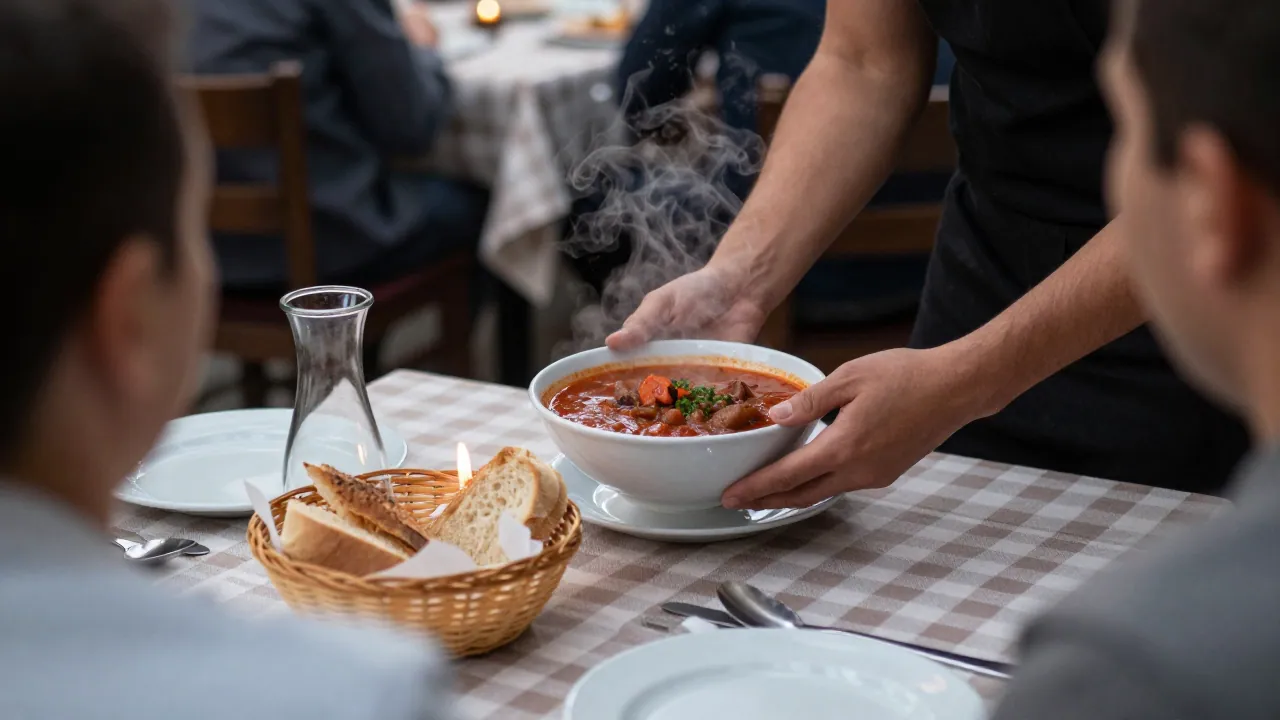
Hungarian cuisine is regional, and the same name can mean slightly different things depending on where you are. <strong>Pörkölt</strong> is a meat stew with paprika and onions, usually served with dumplings or potatoes. <strong>Gulyás</strong> is a soup in Hungary (not a thick stew as it is often served abroad), made with beef, potatoes, and paprika. <strong>Halászlé</strong> is a fiery fish soup, often made with carp and served with noodles; it can be very spicy, so ask if unsure. <strong>Töltött káposzta</strong> is stuffed cabbage, typically pork and rice wrapped in sauerkraut leaves and baked. <strong>Rántott hús</strong> is breaded and fried meat, often pork or chicken, served with potatoes or salad. <strong>Túrós csusza</strong> is a pasta dish with cottage cheese and bacon, sometimes topped with sour cream. <strong>Lángos</strong> is fried dough, usually topped with sour cream and cheese, sold at markets and fairs. These are just a few; the table below compares some common terms.
| Term | Meaning | What to expect |
|---|---|---|
| Rántott | Breaded and fried | A crispy coating, often served with potatoes or salad |
| Pörkölt | Meat stew with paprika | Rich, saucy, usually with dumplings or potatoes |
| Gulyás | Soup with beef and paprika | A brothy soup, not a thick stew |
| Halászlé | Fish soup | Often spicy, with carp and noodles |
| Túrós csusza | Pasta with cottage cheese | Comfort food, topped with bacon and sour cream |
| Lángos | Fried dough | Street food, usually with sour cream and cheese |
Regional differences matter. In the Great Plain, you will find more fish and paprika-heavy dishes; in the north, potato-based dishes and sauerkraut are common. <strong>Hurka</strong> is a sausage made with liver and rice, often served at breakfast or as a starter. <strong>Disznótoros</strong> refers to a plate of pork products, including sausage and black pudding, typical of winter feasts. If you are in a wine region, look for <strong>bor</strong> (wine) on the menu, and <strong>fröccs</strong> is a spritzer of wine and soda water. For more on how we map food traditions, see our article on why many towns have two names, which touches on how language shapes local identity.
What you need and common mistakes
Before you sit down, a few things help. You do not need to bring anything special, but a willingness to ask questions and a little patience go far. Here is what we suggest having on hand:
- A short list of key terms (written down or on your phone).
- A translation app for occasional words, but do not rely on it for whole sentences.
- A note of any dietary restrictions in Hungarian if possible (e.g., <strong>nem eszem húst</strong> – I do not eat meat).
- Small change for markets or casual eateries.
- An open mind for dishes that may look different from what you expect.
Common mistakes include assuming that <strong>gulyás</strong> is a thick stew (it is a soup), or that <strong>halászlé</strong> is mild (it can be very spicy). Another is forgetting that sides are often separate; if you want potatoes with your <strong>rántott hús</strong>, you may need to order them. Also, <strong>köret</strong> can mean a small portion, so if you are hungry, ask for <strong>nagyobb adagot</strong> (a larger portion) or order an extra side. Finally, tipping is common; a 10–15% tip is appreciated if service is not included. For more on navigating local customs, our guide to riding Czech trains offers a similar step-by-step approach to unfamiliar systems.
Putting it into practice
The best way to learn is to order a few dishes and share. Start with a soup like <strong>gulyás</strong> or <strong>húsleves</strong> (clear meat broth with vegetables), then try a main like <strong>pörkölt</strong> with dumplings, and finish with a <strong>túrós csusza</strong> or a slice of <strong>dobos torta</strong> (a layered cake). If you are unsure, ask for a <strong>kóstoló</strong> (tasting plate) if available, or order two smaller dishes. Many restaurants offer half portions (<strong>fél adag</strong>) for lighter appetites. Over time, you will recognize the patterns and feel more at home. For more on how we approach local food ways, see our notes on the clockmaker’s workshop, which reminds us that small details make a place.
We are still puzzled by some regional variations. For example, the exact recipe for <strong>halászlé</strong> changes from town to town, and some menus use local names that do not appear in standard dictionaries. In one village, we saw <strong>töltött paprika</strong> (stuffed peppers) listed under a different name, and it took a conversation to understand. That is part of the fun: the menu is a doorway to asking and learning. If you keep a small notebook of terms you encounter, you will build your own glossary. And if you find a dish you love, ask for its name; it is a good way to remember.
Questions people ask
What does 'rántott' mean on a Hungarian menu?
'Rántott' means breaded and fried, usually referring to meat or vegetables coated in flour, egg, and breadcrumbs. It is similar to a cutlet and is often served with potatoes or salad.
Is gulyás a soup or a stew?
In Hungary, gulyás is a soup, not a thick stew. It is made with beef, potatoes, and paprika, and has a broth-like consistency. Outside Hungary, it is sometimes served as a stew.
How can I ask if a dish is spicy?
You can ask 'Csípős?' (Is it spicy?) or 'Nem csípős?' (Is it not spicy?). If you want little paprika, say 'Kevés paprikával.'