Why So Many Central European Towns Have Two Names
A plain-language guide to the German, Hungarian, Slovak and Polish names that share the same square, and why maps and signs rarely agree.
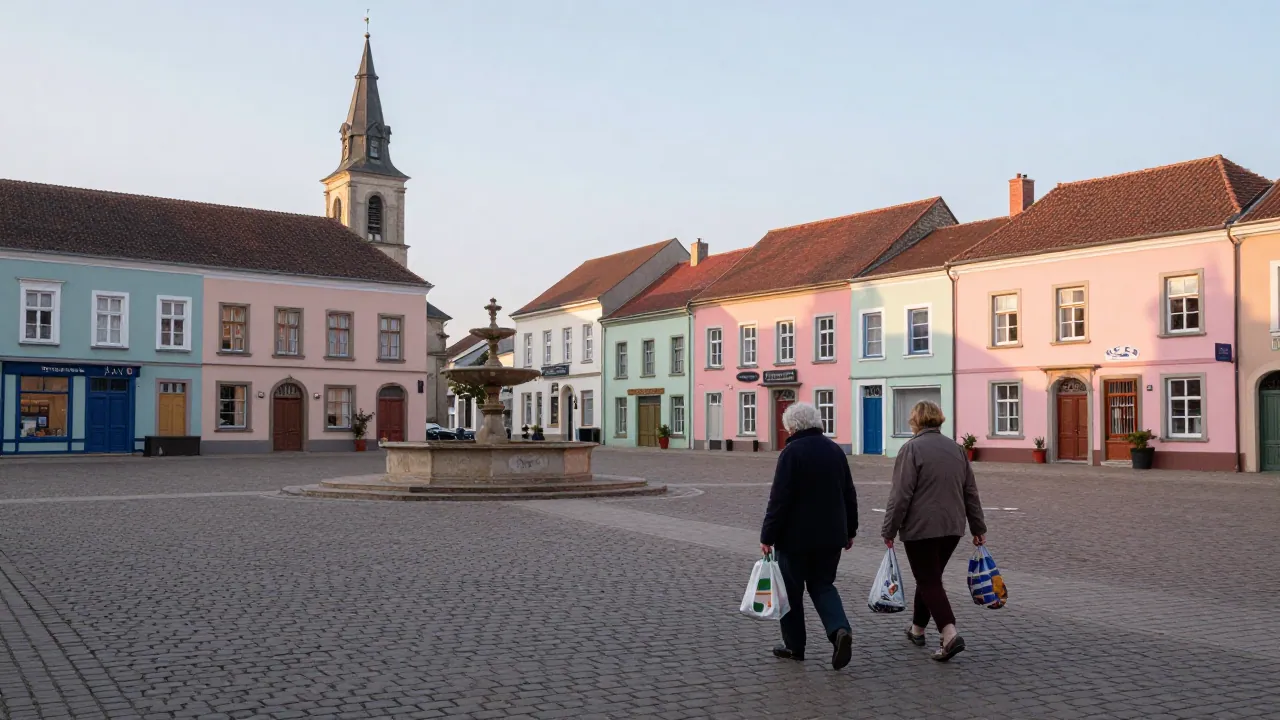
Travelers in Central Europe often notice that a single town can appear under two or three names on maps, road signs and railway timetables. The same square might be called Bratislava in Slovak, Pozsony in Hungarian and Pressburg in German, depending on who is speaking. This is not a trick of translation software or a mistake in the guidebook. It reflects centuries of migration, empire and border change, layered like sediment in the local place names. In this explainer we unpack how those layers formed, what they mean today and how to read them without confusion. As we found while writing about four countries, names are often the first thing that tells you where you are.
The phenomenon is common enough that it rarely surprises locals. In Slovakia, a sign may show Bratislava and Pozsony; in Hungary, a town like Esztergom carries the German name Gran; in Poland, Wrocław was once Breslau; in Czechia, Cheb appears in German as Eger. Each name marks a different community's claim on the same streets. The layers are not random: they follow waves of settlement, shifts in state borders and the slow work of language standardization.
The most visible layer in many places is German. From the twelfth century onward, German-speaking settlers were invited into parts of what is now Slovakia, Czechia, Hungary, Poland and Romania to develop mining towns, trade routes and craft guilds. Their names often describe a function or a feature: a market, a bridge, a hill. When you see Pressburg, Breslau or Eger on an old map, you are looking at that commercial and urban layer, not at a translation of the current official name.
The Hungarian layer is older still in some regions, tied to the medieval Kingdom of Hungary, which at its height covered present-day Slovakia, Transylvania and parts of Croatia. Hungarian names often follow a different logic: they may describe a owner, a saint or a geographic position. After the Treaty of Trianon in 1920, Hungary lost much of that territory, but the names remained in Hungarian usage across the new borders. Today they appear on Hungarian-language signs, in historical texts and in the everyday speech of Hungarian communities in Slovakia, Romania and Serbia.
Slavic layers—Czech, Slovak, Polish and others—became official in the nineteenth and twentieth centuries as national movements standardized languages and new states chose names that matched the majority tongue. Sometimes this meant a direct translation from German or Hungarian; sometimes it meant reviving an older Slavic form. The result is that a town can have a German name from its founding charter, a Hungarian name from its county administration and a Slovak or Polish name from its modern municipality. None of them is wrong; each tells a different part of the story.
How the layers formed
The process usually follows a pattern. First, a settlement gets a name in the local vernacular. Then, a wave of migrants or administrators introduces a new name in their own language, often for taxation or trade. Later, a state border shifts and the official language changes, so the name on the map changes too. Finally, national revivals in the nineteenth and twentieth centuries codify one name as correct and relegate others to historical or minority status. The older names do not disappear; they stay in family memory, in church records and on old buildings.
Take the example of Košice, in eastern Slovakia. The city appears in Hungarian as Kassa, in German as Kaschau and in Slovak as Košice. Each name belonged to a different administrative era. The German name reflects the city's medieval role as a trading hub; the Hungarian name reflects centuries under the Kingdom of Hungary; the Slovak name became official after 1918 and again after 1945. Walking through the old town, you can still see all three in inscriptions, shop signs and memorial plaques.
Why the names matter locally
For local people, names are not just labels. They signal identity, memory and sometimes politics. In towns with a significant Hungarian minority, the presence or absence of a Hungarian name on a public building can become a small controversy. In Czech borderlands, German names were largely removed after 1945, when the German-speaking population was expelled; today they survive mainly in historical tourism and in the work of local archivists. In Poland, the recovery of German names in former eastern territories is part of a broader reckoning with the region's complicated past.
This is also why our editors spend time on place names when we work on articles about the region. A name on a map is a small historical document. When we were checking facts in four languages, we learned to treat every name as a clue: it tells you which archive to consult, which community to ask and which century you are dealing with.
Reading maps and signs without confusion
The practical rule is simple: the large name on a modern map is usually the official name in the state language. The smaller name, or the one in brackets, is often a historical or minority name. On road signs near borders, you may see both the current official name and the name used in the neighboring country. Railway timetables sometimes list the German or Hungarian name for the benefit of travelers from across the border. None of this is meant to confuse you; it is a courtesy and a record.
If you are planning a trip, it helps to know the main variants of the places you will visit. A few common patterns can guide you: German names often end in -burg, -stadt or -dorf; Hungarian names may end in -háza, -falva or -vásár; Slovak and Czech names often end in -ice, -ov or -ín; Polish names often end in -ów, -ice or -sk. These are not strict rules, but they help you recognize that two names might refer to the same place. Before you go, it is worth learning a few menu words in the local language, since the same layered logic applies to food names too.
| Town (official name) | German name | Hungarian name | Polish/Slovak/Czech variant |
|---|---|---|---|
| Bratislava (Slovakia) | Pressburg | Pozsony | — |
| Wrocław (Poland) | Breslau | — | — |
| Košice (Slovakia) | Kaschau | Kassa | — |
| Cheb (Czechia) | Eger | — | — |
| Esztergom (Hungary) | Gran | — | — |
One common misconception is that these double names are a form of translation. They are not. A translation would render the meaning of a name into another language; these names often have different origins and different meanings. Pressburg is not a translation of Bratislava; it is a separate German name that developed alongside the Slavic one. Another misconception is that the older names are no longer used. In practice, they persist in local speech, in historical literature and in the names of businesses and associations. They are part of the living texture of the region.
What this means for curious readers
For anyone reading about Central Europe, place names are a reminder that borders are recent and identities are layered. A town with two names is not a town with two identities, but a town that has been home to several communities over time. When you encounter a name you do not recognize, it is worth pausing to ask which layer it belongs to. That question often opens a door to a richer story about migration, trade or the quiet persistence of minority languages.
We keep this in mind in our own work. When we mapped seasonal food markets, we had to decide which name to use for each market town, and we often ended up listing both the official name and the local variant. It is a small editorial choice, but it reflects the reality on the ground: in Central Europe, a place can have more than one name, and each one is a piece of its history.
Questions people ask
Why does one town have two names on the same sign?
The sign usually shows the official state-language name and a historical or minority-language name. This is common in areas with a mixed linguistic history and is meant to be informative, not confusing.
Are these names translations of each other?
Not usually. They often come from different languages and different historical periods, and they may have different meanings. They refer to the same place but are not direct translations.
Which name should I use when I visit?
Use the official name in the state language for maps, tickets and official business. Locals will understand the common historical names too, but the official one is safest for travel logistics.